 By
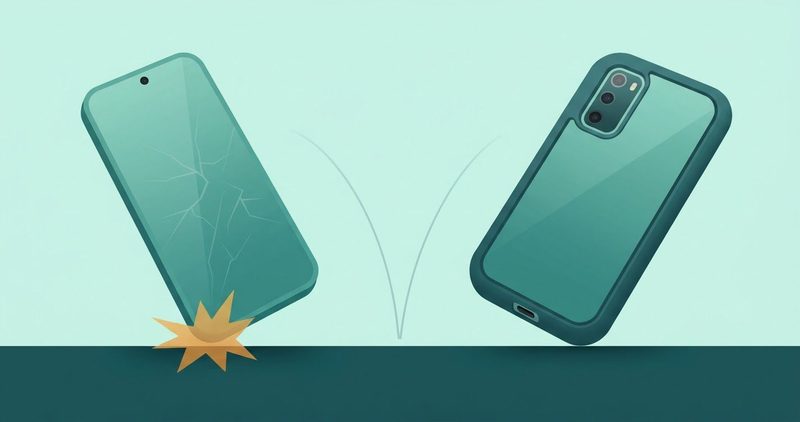
Which Android case protects a phone rated for 1.5m drops? The quick summary
- Read your maker's page first: your rating may beat any case multiplier, and no rubber fixes glass your maker already hardened.
- The $24 pick: Spigen Rugged Armor (MagFit), slim and real foam, with no lip line printed on the maker's page.
- The $42 pick: Spigen Tough Armor AI, printing "Raised edges for screen and camera protection", the one Spigen page with a lip line.
- The heavy-duty pick: OtterBox Defender Pro XT at $48.99 on sale; 7X is 182 drops on the maker's DROP+ page.
- Skip the waterproof Frē for Android: the US shelf reads "No products found in this collection" today.
- Not tested: this site has dropped nothing; buy for lip, fit and price, never for the multiplier alone.
No link on this site pays us today; every link here is a plain link, and the affiliate disclosure is one tap away.
The slim truth about this phone
The Tecno Spark 40 Pro is the phone on my desk this week.
Its weaknesses are said out loud first: Gorilla Glass 7i up front, plastic back, plastic frame, and no wireless-charging coil. Tecno’s own page, read on 19 November 2026, sells it as "as thin as 6.69mm and weighing only 170g". The page's own slogan is "Slim Ever, Strong Forever."
Hold that next to any case you are about to buy. A case is a weight problem before it is a protection problem. Every gram of rubber rides on a phone designed to disappear in a pocket.
The maker page prints IP64, which means dust-tight with splash resistance, and "Drop Resistance Up to 1.5m". The glass line reads "2 times the resistance to falling, shock and friction" against Corning GG5. Tecno also prints over 2,000 charge cycles, with more than 80 percent capacity left at five years.
GSMArena’s build row prints 6.78-inch AMOLED at 163.7 by 75.9 by 6.7mm. Glass front, plastic back, plastic frame. Its weight row prints a dash now, so 170g belongs to Tecno's page alone.
Thick soft cases wrap that back in an insulator. What heat does to it is the subject of my battery draining guide, folklore included.
Drop ratings are not real, this one is
Drop ratings on case boxes are multipliers looking for a baseline, and OtterBox prints one. The drop-rating explainer, published 2026-03-05, is where the 7X comes from.
"Depending on the series, OtterBox cases can handle up to 7X the drops required by the military specifications."
Symmetry gets 3X (78 drops), Frē gets 5X (130), Defender Pro XT gets 7X (182).
OtterBox's DROP+ page prints the baseline. One MIL-STD-810G 516.6 pass is 26 drops from 4 feet.
The page prints the math too: 1X is 26 drops, 3X is 78, 5X is 130, 7X is 182. Three times what? Seven times what? Both answers now carry a page behind them. The multiplier itself is a receipt, not a promise.
Corning, by contrast, names its denominator every time. Its Gorilla Glass 3+ page, read on 19 November 2026, carries one percentage.
The glass "survives a 0.8-meter drop (waist height) onto a hard and rough surface up to 70% of the time."
The GG6 page prints 1.6 meters onto hard, rough surfaces and no percentage at all.
Corning’s GG7i page prints one distance and no percentage either.
"In Corning lab tests, Gorilla Glass 7i survived drops of up to one meter on surfaces replicating asphalt."
Tecno's 1.5m rides on its high-strength fuselage, not the bare glass, so both makers' numbers can be true. No page prints a GG7i survival percentage.
| The claim | Where it prints | Baseline |
|---|---|---|
| IP64 dust and splash | Tecno product page | An IEC code, printed |
| 1.5m drop resistance | Tecno product page | A distance, printed |
| 2x fall resistance | Tecno, versus Corning GG5 | A named predecessor, printed |
| 1.0m on asphalt, lab test | Corning, Gorilla Glass 7i | A distance, printed |
| 70% at 0.8m | Corning, Gorilla Glass 3+ only | Printed, not for this phone's glass |
| 7X military standard | OtterBox Defender Pro XT, its DROP+ page | 1X = 26 drops from 4 feet; 7X = 182 |
| Over 2,000 cycles, 80% left | Tecno battery claim | Cycle count and years, printed |
That leaves one stated baseline in your pocket: 1.5 meters, and IP64. Both carry their units, so both are real numbers you can check.
The pages disagree on which revision applies: 810G on the OtterBox page, 810H on the Supcase page. The standard's own text is not reachable from here. Nothing here settles it.
So the contrast narrows. A maker comparing inside its own product line names the baseline, because both numbers are its own. OtterBox prints a baseline too: 26 drops per pass. Every box in the shop still has to answer one question.
Three times what?
The four questions that decide your case
Slim, hybrid, rugged is one thickness axis. Here is the frame that survives contact with the maker pages, read on 19 November 2026. Prices move weekly, so open the page before you pay.
1. Does it keep the slimness the phone sells?
Who it is for: you, if 6.69mm is the reason you own this phone.
What it does: Spigen's Rugged Armor (MagFit), Pixel 10 version, costs $23.99 today on Spigen's own page, marked down from $39.99. PC, TPU and Extreme Impact Foam. It prints "Military-grade drop protection via Air Cushion Technology" and no number rides with that phrase.
The gotcha: there is no Rugged Armor Extreme on Spigen's Pixel or Galaxy pages today. The tall sibling is Tough Armor AI at $41.99. The Pixel page prints a camera-lip line; the Galaxy features list printed today does not.
2. Does it print an actual drop rating?
Who it is for: you, if a number is what you need before checkout.
What it does: OtterBox's Defender Pro XT prints "7X military standard drop tested" on its maker page. The page covers Pixel 10 and 10 Pro: $69.99 list, $48.99 on sale, 14.20mm thick, 50.27g on the spec table. The same page prints 5X under its drop slider; the description says 7X. The box to trust is your own eyes.
The gotcha: the product page prints no baseline; the DROP+ page does. 7X there is 182 drops from 4 feet.
The Frē series, which would give you "waterproof", prints "No products found in this collection" on the US collection page. Every Frē page the US storefront shows is an iPhone page. Buy the Defender for a job site, not for the word military.
3. Does it protect the camera lip, not the bumper?
Who it is for: you, and this is the question that saves lenses.
What it does: a bumper is the side wall. A lip is the ridge that keeps screen glass and camera rings off the table. Three pages print a lip line.
OtterBox Symmetry, $49.99 on the Symmetry page, prints "Raised edges around the camera protect against hard hits" and a screen lip to match.
That page also prints "3X tested to Military Drop Standard (810G-516.6)", which at least names the procedure. Defender Pro XT prints camera bumpers and the same screen lip.
Spigen's Tough Armor AI, on the Pixel 10 page at $41.99, prints "Raised edges for screen and camera protection".
The gotcha: Spigen's Rugged Armor prints no lip line at all, and thinborne's aramid page says its cases "do not have a 'front lip'". A nine-dollar lip is not a lip you can lean a camera on.
4. Total pocket price
Who it is for: you, right before the card number.
What it does: add the case to the screen protector you were always going to buy. Android Police put it plainly in March 2025.
"The first thing I buy alongside my phone is a screen protector, not a case." The screen is the fragile surface here. The back is plastic.
The gotcha, priced today: Rugged Armor $23.99. Tough Armor AI $41.99 on the Pixel 10 page. The same $41.99 prints on the Galaxy S25 Ultra product page (against a $59.99 list, Black Friday pricing ends Dec 1). Symmetry $49.99. Defender Pro XT $48.99 on sale.
All four claim military-grade something. Two of the four name a multiplier: 3X on the Symmetry page, 7X on the Defender. The Spigen pair prints none. No page stocks a case for this exact phone. The classes travel. The SKUs do not.
The skip-list
- Thinborne's aramid case. The maker's Pixel 10 page prints 0.04 inch, about 1.01mm, and a $69.98 price on the US page. Its own FAQ caps it at "everyday protection from bumps, scratches, dirt, and minor drops". Scratches, yes. A real fall, no front lip, no contest.
- "Waterproof" Frē for Android. The US Frē shelf reads "No products found in this collection". Any listing promising it is older than the shelf.
- "Shockproof" with no material and no lip. If the page will not name PC, TPU or a foam, and will not print a lip line, the rating is a sticker. Your phone's 1.5m outranks the sticker.
What the two-week test would show
Straight answer: not tested. This site has bought no case, dropped no phone, and run no two-week log with a case column. Anyone who tells you they tested fourteen cases can show you the log, or they cannot.
If this site bought one of each tomorrow, here is what the test still needs.
A drop log with heights and angles, a tare (the empty case on the scale), and a weekly weight creep. Also on the list: a camera-lip check against a table edge, and a charge-time note beside the case column. None of it exists yet.
The thermal half gets one claim, and it belongs to a case brand. Supcase’s page, dated 2026-05-21, says hard polycarbonate conducts heat away better than soft silicone or rubber. That is a case brand selling the cooler case, so it is quoted as a claim, not as settled fact.
The chain the field repeats runs thick case, trapped heat, throttled phone, battery ages sooner. The last link is folklore. My charging mistakes post counts wear in full cycles, not in sessions at the cable.
Ten shallow top-ups cost the cell less than two or three full drains. Heat does cost you speed and deeper cycling over time, and my overheating guide covers that side. The charging-more-often claim does not survive full-cycle math.
So the honest position for now: a price and a print list, never a drop result. If the two-week log ever runs, this section gets replaced with numbers, and the post will say so.
What to do next
Run this before the card number, in order:
- Open your maker's durability page and note three prints: the drop distance, the ingress code, and the glass name. No baseline printed means the box is guessing with you.
- Open the case page. Look for a lip for camera and screen, a named material, and one number with a unit: mm, grams, meters.
- Put the bare phone face down on the table. If any camera ring touches the wood, you want the lip, and the Defender or the Tough Armor AI are the print-backed answers.
- Weigh the phone, then the phone in the case. A case adding a third of the phone's weight is a brick with a barcode; decide if that trade is yours.
- Buy the screen protector first. Every source above points at the same fragile surface.
- Walk away from any Frē "waterproof for Android" listing you cannot verify on the maker's own shelf.
Buy one of the four above, set the phone face down on the table, and look at the lip before you check out. For the wider shelf of pocket-worthy gear, my accessories pillar ranks the rest.
Checking a used phone's back and glass before you pay is in my used phone check. The 12-check version for your own phone is the test plan.
The hub for everything else that breaks is Android problems fix.
Buy the lip, not the lecture.
Comments
New posts held for reviewCouldn't load comments - the thread service didn't answer. Nothing is being hidden: no approved comments are saved with this page.
No approved comments yet - the first one is yours. New posts are held for review before they appear.