 By
Which fast charger is worth buying for Android? The quick summary
- A USB Power Delivery charger is the pick for most Android phones: the phone asks and the charger supplies.
- Match your phone's ceiling, not the biggest number on the shelf: Samsung's wired tiers are 15W, 25W, 45W and 60W.
- Anker 735 Nano II 65W is the 65W pick that also runs a tablet or a laptop off the same brick.
- Samsung EP-T6010 60W is the pick if your phone is the Galaxy S26 Ultra, or you want Super Fast 3.0 headroom.
- VOOC and SuperVOOC work on OPPO, OnePlus and Realme handsets only, and no US wall-charger channel exists for them.
- The cable is half the charger: at 45W, Samsung's own rule needs a 5-amp cable.
No link on this site pays us today. Every link here is a plain link, and the full affiliate disclosure is one tap away.
1. Your phone negotiates, not the box
Your phone sits at 9% at three in the afternoon, and you have a meeting at four. Your phone is negotiating with whatever brick is nearest right now. The only question is whether you know what it is asking for.
Anker's own support page: the device being charged negotiates what it needs and our charger supplies that. Read it twice. It kills the fanciest sentence in this business.
The same page says a charger rated 60W or higher will not harm smaller devices like an iPhone or a Samsung Galaxy. One brick for your phone, your tablet and your laptop is the entire pitch. A charger brand said it about its own hardware.
A mismatched charger is not a failure, either. Wikipedia's Quick Charge page says both device and charger must support Quick Charge. Otherwise regular USB charging happens instead. You lose speed, never safety.
A bigger charger is safe and pointless in equal measure. The phone takes what it wants and leaves the rest on the table, every single time it negotiates.
2. Three names on the box, one owner each
The logos are the confusing part. Each one belongs to somebody, and knowing who tells you whether it applies to you.
Quick Charge is Qualcomm's. Wikipedia defines it as a proprietary battery charging protocol for phones that run on Qualcomm chips. Standard USB BC 1.2 tops out at 7.5 watts, and Quick Charge raises the voltage above it.
Its newest versions are built to fall back to USB Power Delivery. Quick Charge 4 is cross-compatible with USB-C and USB PD, with fallback to USB PD when either side lacks it.
VOOC is OPPO's. OPPO's own newsroom says it was invented for the 2014 Find 7. It moves the transformer into the adapter. It relies on a custom SoC inside the phone running OPPO's closed protocols.
The same story says OPPO has issued flash-charge patent licenses to more than 20 companies. That is why OnePlus and Realme ship a compatible ladder, and why nobody else does. SuperVOOC 2.0 runs at 65W, ten volts and 6.5 amps.
USB Power Delivery belongs to everybody. Wikipedia's USB PD history records the targets: 60 watts in 2012, 100 watts in 2013 and 240 watts in 2021 with PD 3.1.
PPS is the quiet part of the logo. Programmable Power Supply lets the charger adjust voltage in small steps instead of fixed jumps. Samsung's table names it inside the 25W and 60W tiers.
The open standard caught up. The Wikipedia entry records why USB was chosen: "reducing the proliferation of proprietary chargers."
It worked. Recent Galaxy S Plus and Ultra models sold in the US negotiate the 45W tier over Super Fast 2.0.
3. Samsung's table nobody republishes
Samsung publishes a per-model charger compatibility table. The UK page, read on 15 November 2026, says "Updated : 29th October, 2026". It is the single most useful page in the whole category.
| What Samsung calls it | Watts | What it is |
|---|---|---|
| Adaptive Fast Charging | 15W | USB-A output. |
| Super Fast Charging | 25W | USB-C Power Delivery with PPS |
| Super Fast 2.0 Charging | 45W | Requires a compatible USB-C cable. Any devices lacking this will charge slower. |
| Super Fast 3.0 Charging | 60W | USB-C PD 3.1 PPS, EP-T6010 |
Two of the four tiers name USB Power Delivery, in Samsung's own words. The fastest tier is PD 3.1 with PPS. The logo on the brick is decoration.
The page spells out the two rules that matter.
For the 45W tier: "Any devices lacking this will charge slower."
The 25W row carries Samsung's 5A clause: "With 45W TA, it's only possible with a combination of 45W TA and a 5A cable."
Only the S26 Ultra carries Super Fast 3.0 on that list. The Plus and Ultra variants of recent Galaxy S series, and A57/A56/A37/A36, check the 45W tier. Samsung's page answers "does my phone need its own charger", and nobody republishes it.
Read the table next to your model before you shop. If your row checks only the 25W tier, the 45W and 60W bricks buy you nothing over a cheaper, smaller 25W one.
The USB-IF certification mark deserves your attention. The USB-IF's certified products page lists protocol testing, battery charging and interoperability. Cable and connector testing runs to 10,000 insertions.
That mark covers compliance with USB-IF specifications. It does not cover your phone's proprietary protocol. A USB-IF certified brick is honestly made, tested and interoperable, even for a phone that negotiates nothing faster than USB PD.
4. The cable is half the charger
Samsung's 5A cable requirement belongs to its own 45W TA with PPS, and nowhere else. The cable is not an accessory there. It is a specification Samsung prints in its own table.
A charge-only cable can fail harder. Wikipedia's USB page notes these cables short the data wires. A device "may reject the charger as unsuitable". That is why a random cable can make a working charger look broken.
Length matters too. Raising voltage is what pushes more watts through a wire without the heat that current would cause. Resistive loss climbs with cable length, and Quick Charge exists partly because of that.
Cables carry their own current rating. Get the 5A-rated cable for the Samsung 45W TA and charge on.
5. What to buy at US retail
Four questions decide this, in order. Skip the first three and the fourth is money down the drain.
1. What does your phone accept? Check the product page or battery settings, not the accessory box. 2. Is it USB-IF certified if the mark is present? 3. Does your cable carry 45 watts? 4. Is the next step up worth more than the one your phone peaks at?
Worked example: a Galaxy S25 Ultra tops out at 45W, so a 60W brick adds nothing over a 45W one. Buy for the row you tick in your model's table.
1. Anker 735 Nano II 65W
Who it is for: anyone whose phone, tablet and laptop share one socket. Sixty-five watts on a single USB-C port, PPS, three ports and GaN size.
Two USB-C ports run 45W plus 20W together, or 40W plus 22.5W with the USB-A port filled. That is a tablet on one port and a phone on the other, off one brick.
What it costs today: $29.99 on anker.com as of 15 November 2026, in stock there. Street prices move by the week; check the listing before you buy.
2. Samsung EP-T6010 60W
Who it is for: you, if your phone is a Galaxy S26 Ultra waiting for Super Fast 3.0. It is Samsung's latest USB-C PD 3.1 PPS charger. Earlier Galaxy devices fall back to their maximum supported speed.
What it costs today: $54.99 on the Samsung US page as of 15 November 2026. The UK product page returns not-found today. Both change; check before you order.
An oversized certified brick is safe and pointless; an uncertified one is the risk at any wattage. My charging mistakes guide covers the no-name danger in full, so this page does not repeat it.
The VOOC family has no US wall-charger channel. OnePlus US lists an 80W SUPERVOOC car charger at $39.99, out of stock, read on 15 November 2026. If you own an OPPO, OnePlus or Realme, buy the matching brand's brick. Everyone else: USB PD and the four questions above.
Skip the 240W desktop brick for phone-only use. It charges your phone exactly as fast as one step below it, and it costs you a desk's worth of cash.
6. What your lock screen shows while it charges
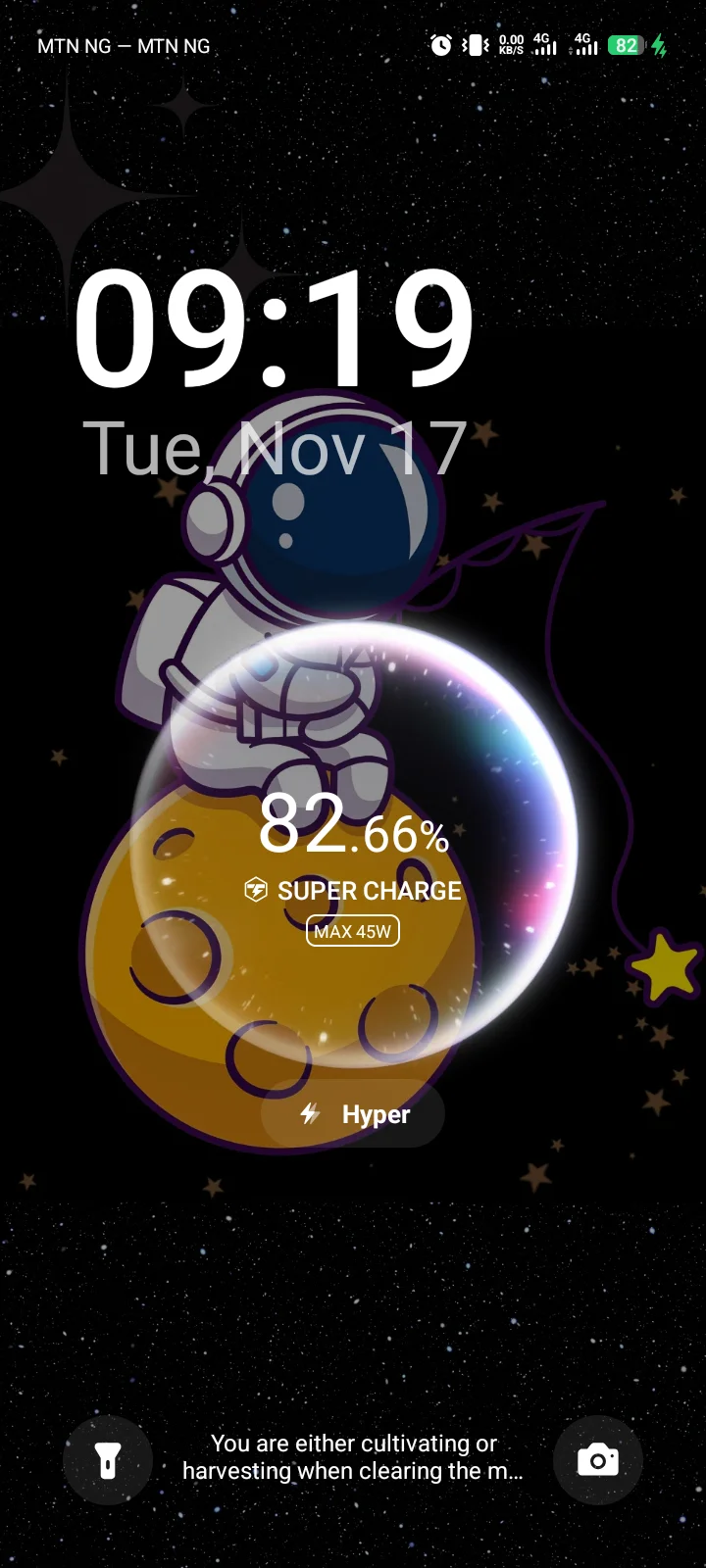
While the phone charged, my Spark 40 lock screen printed SUPER CHARGE, a MAX 45W pill, and Hyper beside a lightning icon. The battery read 82.66 percent at 09:19 on Tue, Nov 17.
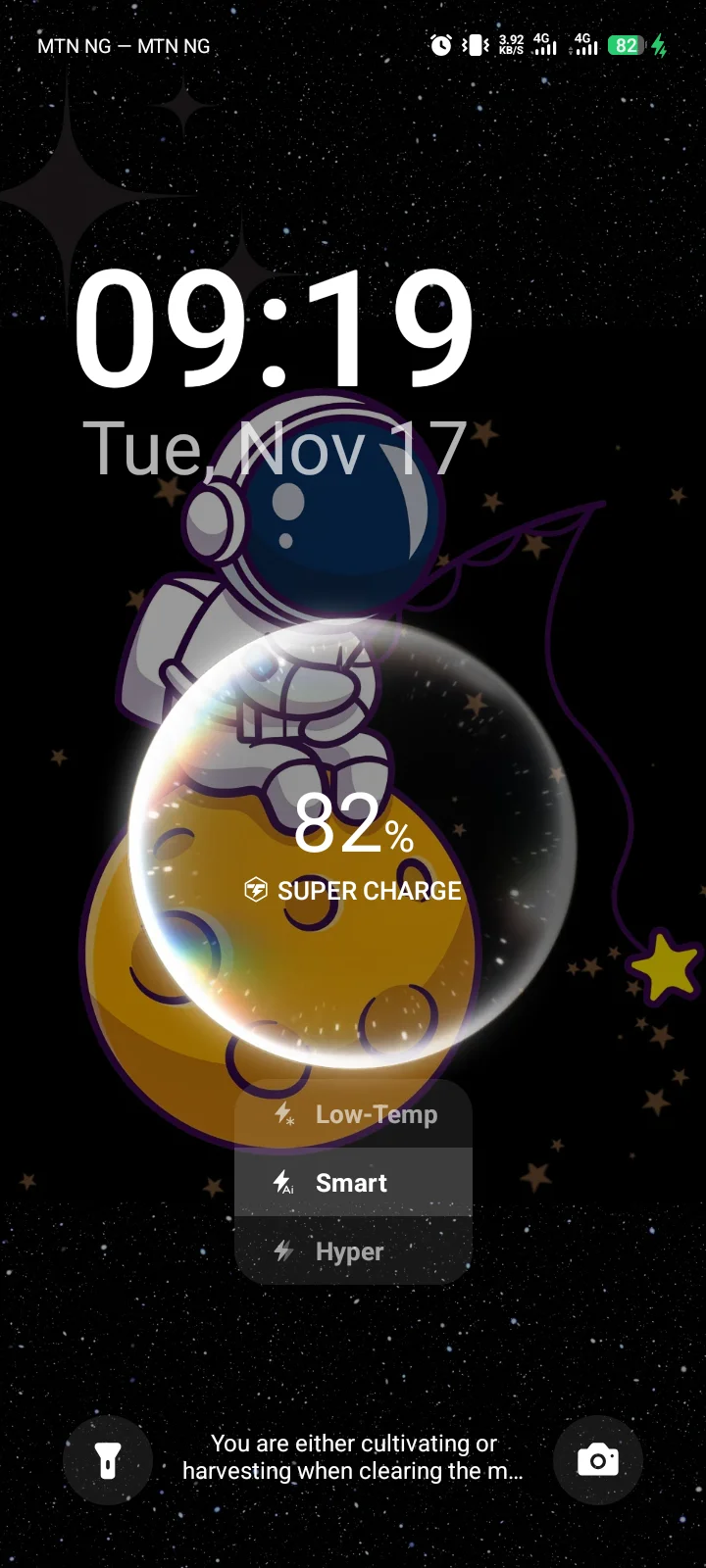
The charging menu sits on that same lock screen. Low-Temp, Smart and Hyper are the three choices, with Smart selected. The phone runs those modes. The brick supplies the power, and the phone decides what to do with it.
What the screens do not prove is a minutes-to-80 time. My two phones have not run that timing check, so there is no table. Guessing would be worse than skipping.
The two-phone check is simple. Same charger, same cable, same start percentage, two phones. The older phone is the control. If the two numbers disagree, the phone set your speed, not the logo.
What you can do today: plug in, open battery settings and watch what the screen declares. Then try my 12-checks used phone test with a charge cycle, or the used phone battery watch before your next upgrade.
If charging is slow or heat is the worry, my battery drain post covers the AccuBattery log. The overheating post covers what charging heat does to a battery.
7. If you are shopping in Nigeria
Dollars are the frame of this page, and no naira figure appears on it. Anker's US shipping pages publish no delivery policy for Nigeria; they returned not-found when last checked. Anker.com, Amazon US and Samsung.com deliver inside the US.
The search results for this question in Nigeria returned stockists, social video and no manufacturer specification page. Prices move with forex and stock, so read the listing on the day you buy.
8. Questions readers ask
Can I use an iPhone charger on Android?
Yes. A USB PD brick from Apple is a USB PD brick, and your phone will negotiate whatever it can. You lose nothing but the Android-specific ladder, if the phone has one.
Will a 100W charger hurt my phone?
No. The phone asks for what it needs, and the charger supplies it. What you overpay for is speed your phone cannot use, not damage.
Do I need my own brand's charger?
Only VOOC, SuperVOOC and Adaptive Fast above 25W need your own brand's brick. Everything else on US retail is a certified USB PD brick sized to your phone's ceiling.
Can a phone charge faster than the charger offers?
No. A 25W brick fills a 25W bucket. If your phone asks for 45W and the brick offers 25W, you get 25W, and the phone handles it safely.
Why does my phone charge slower on some cables?
Cables carry a current rating. Samsung's 5A rule belongs to its own 45W TA with PPS. A charge-only cable may be refused outright. Samsung prints the rule in its own table for a reason.
9. What to do next
Check your phone's ceiling on the product page or in battery settings. Buy a certified USB PD brick sized to your phone, plus a 5A cable if you are buying Samsung's 45W TA. Plug in and see what your screen says.
The brick does not know your meeting. Your table does. Read it before the cashier does.
Comments
New posts held for reviewCouldn't load comments - the thread service didn't answer. Nothing is being hidden: no approved comments are saved with this page.
No approved comments yet - the first one is yours. New posts are held for review before they appear.